One of the best ways to use a Synology NAS is to store photos. If you have an iPhone, a Synology NAS and have been searching how to backup iPhone photos automatically, read below for this very easy solution. Updated 1/3/21 – As of this update, this new shortcut setup works on iOS 14.2 on an iPhone XR. I have an osx mac 'photo library' on my laptop. I want to offload it the NAS, in one of two ways: Just move the library to the NAS (and create a symbolic link for the app). Migrate Photo Library to Synology Moments; I've read somewhere that the 'photo library' only supports drives that are formatted in MacOS Extended with Jounraling.
Before you set up Home Sharing
- Update all of your Apple devices to the latest versions of iOS, iPadOS, macOS, and tvOS. On your PC, make sure that you have the latest version of iTunes for Windows.
- Connect all of your devices to the same Wi-Fi or Ethernet network.
- Make sure that all of your devices are signed in with the same Apple ID and authorized to play purchases using that Apple ID.
Apps and features might vary by country or region. Learn more about what's available in your country or region.
Set up Home Sharing
Before you can use Home Sharing, you need to set it up on your Mac or PC.
Set up Home Sharing on your Mac
- Choose Apple menu > System Preferences.
- Click Sharing.
- Click Media Sharing.
- Select Home Sharing and sign in with your Apple ID. Use the same Apple ID for every computer or device on your Home Sharing network.
- Click Turn On Home Sharing.
Set up Home Sharing on your PC
- Open iTunes for Windows.
- If you're not signed in, sign in with your Apple ID. Use the same Apple ID for every computer or device on your Home Sharing network.
- From the menu bar at the top of the iTunes window, choose File > Home Sharing > Turn on Home Sharing.
You can use Home Sharing with up to five computers that are connected to your home Wi-Fi or Ethernet network.
Use Home Sharing
On your Mac or PC, you can use Home Sharing to see shared libraries from other computers that are connected to the same Wi-Fi network and signed in with the same Apple ID.
To see a shared library from a computer on your iPhone, iPad, iPod touch, or Apple TV, you need to be signed in with the same Apple ID as the computer and connected to the same Wi-Fi network.
You can use Home Sharing to access your media library across computers that are on the same Wi-Fi network. And you can stream music, movies, and TV shows from one authorized computer to another. Just make sure that your computers are powered on, awake, and have the Music app or iTunes for Windows open.
Use Home Sharing on your Mac
To access your media library:
- Open the Music app.
- If you're not signed in, sign in with your Apple ID. Use the same Apple ID for every computer or device on your Home Sharing network.
- In the sidebar, click Library.
- Click the media library.
To go back to your music library, click Eject in the sidebar.
Use Home Sharing on your PC
You can use Home Sharing to stream music, movies, and TV shows from one authorized computer to another. Just make sure that your computers are powered on, awake, and have the Music app or iTunes for Windows open.
To see all of your shared libraries, click Music in the upper-left corner of the iTunes window.
Use Home Sharing on your iPhone, iPad, or iPod touch
To use Home Sharing to access your computer's media library on your iPhone, iPad, and iPod touch, sign in to Home Sharing on your device:
- To see a music library, go to Settings > Music. To see a video library, go to Settings > TV > iTunes Videos.
- Under Home Sharing, tap Sign In.
- Sign in with your Apple ID. Use the same Apple ID for every computer or device on your Home Sharing network.
After you sign in, connect your iPhone, iPad, or iPod touch to the same Wi-Fi network as your computer, and open the Music app, Apple TV app, or iTunes for Windows on your computer.
See shared music
- Open the Music app and tap Library.
- Tap Home Sharing. Don't see it? Tap Edit, select Home Sharing, then tap Done.
- Choose a shared library.
See shared videos
- Open the TV app.
- Tap Library.
- Choose a shared library.
Use Home Sharing on your Apple TV
To use Home Sharing to access your computer's media library on your Apple TV, sign in to Home Sharing on your Apple TV:
- Go to Settings > Users and Accounts > Home Sharing.
- Select Turn on Home Sharing.
- Sign in with your Apple ID. Use the same Apple ID for every computer or device on your Home Sharing network.
After you sign in, follow these steps to access your computer's media library on your Apple TV:
- Connect your Apple TV to the same Wi-Fi network as your computer.
- On your computer, open the Music app, Apple TV app, or iTunes for Windows.
- On your Apple TV, go to the Home screen, select Computers, and choose a shared library.
You can also view photos from your computer on your Apple TV.
- On your Mac: Choose Apple menu > System Preferences. Click Sharing. Click Media Sharing, then select Share Photos with Apple TV.
- On your PC: Open iTunes for Windows. In the menu bar, go to File > Home Sharing, then select Choose Photos to Share with Apple TV.
Transfer iTunes
- 1. Music Transfer
- 2. iTunes Playlist
- 3. iTunes Tips
- 4. Others
Is it possible to transfer iTunes library from mac to pc and/or pc to mac?
Many people have such puzzles, because iTunes is likely best known for its Mac associations, it’s quite likely that there are many households that only have their iTunes library on a Mac. If, however, a family member with a PC is heading off on a holiday and wants to bring their tunes or entertainment selection with them, it may be difficult to simply leave the copy of iTunes on one machine. It therefore makes sense to learn how to copy iTunes from a Mac to a PC to allow for greater portability for either system or either system’s music and entertainment files.
Part 1: Simplest Way to Transfer iTunes Library from Mac to PC
When it comes to how to move iTunes libary from Mac to PC, here we highly recommend iMusic from Aimersoft to you. It is a All-in-one-music management tool to tranfer, backup, restore your iTunes library Music from Mac to PC. Besides, it could also download , record music from over 3000 sites including DRM protected music, check the following more features:
Export iTunes Library from Mac to PC with Simple Clicks - iMusic
- All-in-one Music Management to Move iTunes Library from Mac to PC without Any Hassles.
- 1-click to backup iPad music to iTunes Library/Mac.
- Transfer music from Mac/PC/iTunes to iPhoneXR/XS/8/8plus/Android phone easily.
- Download music from over 3000 music sites, including download YouTube to MP3.
- Record music from any radio stations with music tag, covers, album name attached.
- Built-in library collected thousands of songs for free download.
Guide to Transfer iTunes Library from Mac to PC by iMusic
To transfer iTunes library from Mac to PC, here we could use iMusic's Backup iTunes library function.
Step 1. Run iMusic on your Mac Computer
Come to iMusic 's official website to download it's free trial version or click the following box to download it and then run it.
Step 2. Enter into the 'Toolbox'
Click the 'Toolbox' on the ribbon to enter the toolbox window, then choose the 'Backup/Restore iTunes' icon.
Step 3. Choose the 'Backup' option
Next the interface will pop up two icon mark, choose the 'Backup' option.
Move Itunes Library From Mac To Synology Nassau Bahamas
Step 4. Select the content you want to backup
Follwoing it's procedures, you will go to choose the music, movies, and other downloaded content to backup.
Step 5. Finish the process to backup iTunes Library
After choosing the music you want to backup to iTunes Library, then choose the foler route on your Mac and click 'ok'.
Move Itunes Library From Mac To Synology Nascar
Step 6. Transfer iTunes Library from Mac to PC
Open one of your other PC like Windows computer, and download the iTunes,and iMusic as well, launch iMusic, go to it's music icon on the left top corner, and then click the 'Add' icon on the right top corner to add the files from your iTunes file.
Part 2: Free Way to Transfer iTunes Library from Mac to PC
There are only a few steps involved with transferring your iTunes library from one computer to the other, and it does not matter, at least as far as iTunes is concerned, whether you are transferring from Mac to PC or the other way around. It is not a terribly complicated process, but it is one that must followed accurately in order to ensure the successful transfer of iTunes from your Mac to a PC.
Step 1. Open iTunes on your Mac
You need to open iTunes on your Mac in order to access your Preferences settings on your iTunes for Mac. Without working on your Preferences settings, you cannot successfully transfer iTunes from one computer to the next.
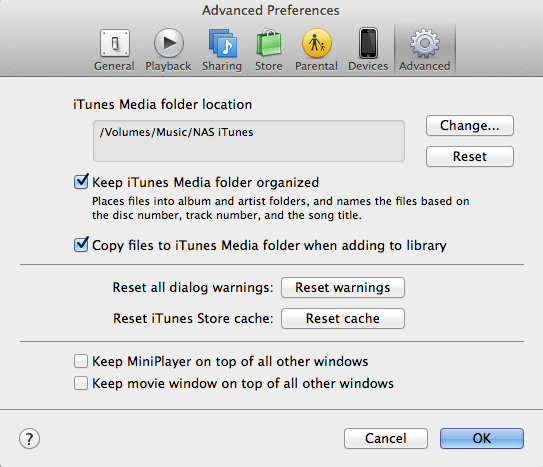
Step 2. Go to iTunes > Preferences
From here, you need to hit the Advanced settings in order to set the Mac to be able to transfer iTunes successfully over to your PC.
Step 3. Under Advanced in Preferences, click “Keep iTunes Media Folder Organized”
This will ensure that all your files are pointing in the right direction for your library, which ultimately makes the transference of your files easier. With an organized iTunes Media folder, your job in transferring iTunes from one system to the other becomes far less complicated.
How To Move Itunes Library To Synology Nas
Step 4. Click File > Library > Organize Library
This will help you to keep your songs organized in order to ensure they are in the same spot when you transfer them over to your new computer. You should also click “Consolidate Files” at this point as well; that will also help you by putting copies of all media files in the iTunes Media folder and keeping all original files in their original locations. This way all the files are pointing where they should to the locations on your drives and they should be accessible when you complete the transfer to the new computer.
Step 5. Plug your portable hard drive into your Mac
This gives you a hardwired location to which to transfer your iTunes from your Mac. On this new computer, try to take the time and put your iTunes files in the same location that you want to put it on the PC, more or less. Certainly, PC’s have a slightly different naming convention than for Mac. Confirm that there is a Music folder on your PC, and within that folder should be the iTunes folder. You can transfer the iTunes Library file and the iTunes Music folder from the portable drive to this folder.
Step 6. Change the name of the iTunes Library file
Because PC systems always need file extensions on them in order to be recognized and opened appropriately, you need to take the iTunes Library file that you just transferred from your Mac and change the name so that it has the right file extension. Right click on the iTunes Library file and rename it to iTunes Library.itl, and that should allow you to open every file that you had working in the Mac version of the program.
It should be noted that when you migrate iTunes from one computer to the other, the backups that you might have made of Mac handheld devices, such as iPhones, iPads and iPods, through iTunes will likely be lost. In addition, if you do not migrate your iTunes to the exact same location on the new PC, iTunes will not be able to find the media files, and then you might have a problem effectively using the program. So, take the time to migrate the files to the right location to ensure that you will be able to find them on the new PC.
At times, though, you may find it extremely helpful to transfer your iTunes library to an external hard drive simply in order to have a backup of your iTunes library. Having your iTunes library on an external hard drive also means that should you want to share that library with another computer or another person, you will be able to do so quite easily; if you have your external hard drive with you, it is simply a matter of taking the copy of iTunes and moving it you’re your portable hard drive to the system of your choice. Having a copy of iTunes on an external hard drive also gives you a certain degree of calm, as there have been multiple times where people have inadvertently lost everything on their computers, their iTunes files included. This can be incredibly distressing when it happens, and people want to be able to avoid this. It can sometimes take hours to build up an iTunes library, and this is time that many people do not always have.
Sometimes, people want to be prepared in the event they lose all the information on their computer, and an external hard drive can be a great tool to back up an entire hard drive on a laptop or on a desktop computer. This includes your iTunes library. Music and entertainment appear to be what make the world go round; after all, music is frequently used as a method of stress release, and we now live in a society where many expect to have a variety of forms of entertainment right at their fingertips. Having your entire iTunes library go missing on your computer can be distressing, but it does not have to be, as backing up the library to an external hard drive can prevent a great deal of stress.
Move Itunes Library From Mac To Synology Nas
iMusic - Most Excellent Music Tool to Transfer iTunes Library from Mac to PC
- Transfer iTunes Library from Mac to PC without erasing or lose the files.
- Record music in original quality and automatically split the ads.
- Discover and download music from more than 300,000 songs.
- Transfer music between any two devices directly without iTunes.
- Fix music library intelligently with correct ID3 tags.